
Table of Contents
- The Four Enemies of Coffee Freshness
- How to Store Fresh Roasted Coffee Beans: Step-by-Step
- Best Coffee Storage Containers for Freshness
- Should You Freeze Coffee Beans?
- Coffee Bean Shelf Life: What to Expect
- Common Storage Mistakes That Ruin Fresh Coffee
- Frequently Asked Questions
Last Updated: September 26, 2026
The Four Enemies of Coffee Freshness
Fresh roasted coffee starts losing quality within days of roasting, and four things speed that decline: oxygen, moisture, heat, and light. Learning how to store fresh roasted coffee beans means blocking all four at once. Do that, and a good roast stays vivid for weeks instead of days.
Oxygen is the worst offender. When air meets the oils in a roasted bean, oxidation begins and the flavor turns flat and papery. Moisture is next. Humidity pulls water into the bean, which weakens the oils and makes everything taste dull. Heat speeds up both reactions, and light breaks down the compounds that give coffee its aroma.
Here's the part most guides get wrong: these enemies work as a team.
How to Store Fresh Roasted Coffee Beans: Step-by-Step
The best way to store fresh roasted coffee beans is to keep them whole, sealed in an airtight opaque container, and placed somewhere cool, dark, and dry. Three steps cover it. Get these right and you protect the flavor profile from the day the bag arrives.
Step 1: Keep Beans Whole Until Brewing
Whole bean coffee stays fresh far longer than pre-ground. Grinding breaks the bean open and exposes a huge surface area to oxygen all at once. That is why pre-ground coffee goes stale in days while whole bean holds for weeks.
Step 2: Choose an Airtight, Opaque Container
You want a container that seals out air and blocks light. Opaque beats clear every time, because UV light degrades the volatile compounds that carry aroma. Look for a tight gasket seal and, ideally, a one-way valve.
Step 3: Store in a Cool, Dark, Dry Place
Skip the shelf above the stove and the sunny windowsill. Both add heat and light, the two enemies that speed up oxidation. A closed cupboard away from appliances works well.
Best Coffee Storage Containers for Freshness
The best coffee storage containers are airtight, opaque, and sized to hold about a week or two of beans. Match the container to how fast you drink, because a half-empty big jar just means more air around your beans.
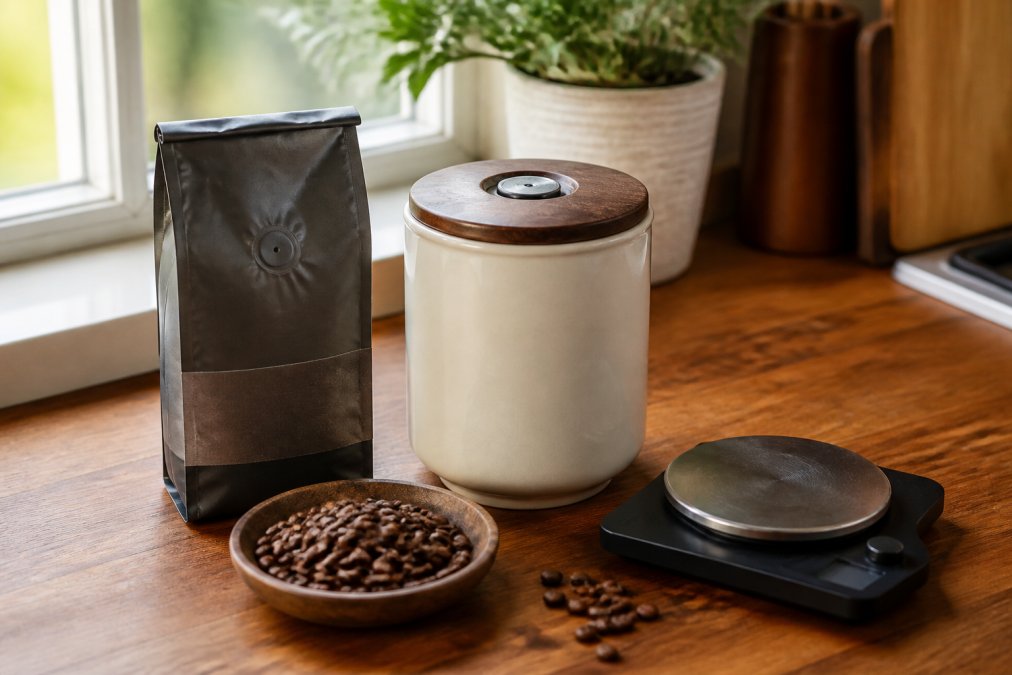
Container Material Science: What Blocks Light and Gas
Stainless steel is the strongest all-around performer. It is fully opaque, so it blocks 100% of UV and visible light. It does not absorb or release odors, and it holds temperature steadily, which slows the heat-driven side of oxidation. The trade-off: you cannot see how much coffee is left, and lower-grade steel can pick up a metallic smell if it is not food-grade.
Why the One-Way Valve Matters
A one-way valve lets carbon dioxide escape during degassing while keeping oxygen out. Fresh roasted beans release CO2 for several days after roasting, and in a fully sealed container that gas builds pressure. The valve solves this without letting air back in. That single feature is why good coffee bags have one, and why a valve-equipped canister outperforms a plain airtight jar during the first week after roast.
Matching Container Size to Consumption
The single most overlooked variable is headspace. Every time you open a large container, you exchange the CO2-rich atmosphere inside for room air. A container sized to hold roughly one to two weeks of beans minimizes the number of open-close cycles and the volume of air each cycle introduces. If you buy in bulk, split the beans into several small containers and open only one at a time.
Should You Freeze Coffee Beans?
Freezing coffee beans can extend freshness, but only if you do it right. The freezer slows oxidation and keeps beans close to peak flavor for longer. Done poorly, though, it introduces moisture and freezer burn that wreck the roast.
How to Freeze and Thaw Beans Without Damaging Flavor
The biggest mistake is thawing beans at room temperature. That pulls condensation onto cold beans and adds moisture you spent all this effort keeping out. Here is a thawing protocol that protects flavor:
- Pull the container from the freezer the night before you brew.
- Let it thaw sealed, still closed, on the counter.
- Wait until the beans reach room temperature before opening.
- Grind immediately after opening, then brew.
- Never refreeze beans you've already thawed.
Coffee Bean Shelf Life: What to Expect
Coffee bean shelf life is shorter than most people assume, and it depends on roast level, storage, and whether the beans are whole or ground. The single biggest variable most guides ignore is roast level, because it changes the physical structure of the bean.
Why Roast Level Changes Shelf Life
During roasting, beans expand and become more porous as moisture and CO2 escape. A dark roast is roasted longer and hotter, so it develops more internal cracks and a more porous structure. That porosity means more surface area exposed to oxygen inside the bean, so dark roasts oxidize faster and peak sooner. A light roast retains a denser cell structure, holds its brightness longer, and can taste flat for the first few days after roast before it opens up.
Shelf Life by Storage Setup
Here is a rough guide to plan around. These windows assume whole beans and a roast date you can trust:
| Storage Setup | Beans | Approx. Peak Window |
|---|---|---|
| Airtight, opaque, cool, dark | Whole bean, light roast | 3-6 weeks |
| Airtight, opaque, cool, dark | Whole bean, dark roast | 2-4 weeks |
| Original bag, sealed, cool | Whole bean | 1-2 weeks |
| Airtight container | Pre-ground | 3-7 days |
| Freezer, airtight, thawed well | Whole bean | Several months |
The Roast Date Is the Number That Matters
Roast date is the number that matters most, not a printed best-by date. Best-by dates are often set months out for inventory reasons and tell you nothing about when the coffee actually tastes best. Buy from roasters who print the roast date, and brew within the freshness window. This is one reason small-batch weekly roasting matters: the beans reach you closer to their peak.
How Storage Conditions Shift the Window
Two environmental factors quietly shorten every window above. Humidity is the first: in a humid climate, beans pull moisture from the air each time the container is opened, and that moisture accelerates the staling reactions. Sealing tighter and buying smaller batches helps. Altitude is the second: at high elevation, lower air pressure means beans degas faster, so the peak window arrives sooner and passes sooner.
Ground vs. Whole: The Multiplier
Grinding is the single largest shelf-life multiplier. A whole bean exposes only its outer surface to oxygen. Grinding shatters it into hundreds of particles and exposes the entire interior at once, so the oxidation rate jumps from weeks to days. If you grind the whole bag at once, you have effectively converted a multi-week window into a multi-day one.
Common Storage Mistakes That Ruin Fresh Coffee
Most storage mistakes come down to adding one of the four enemies back in. The good news is they're easy to fix once you spot them.
- Storing in the fridge: moisture and odors creep in. Skip it.
- Using a clear jar in sunlight: UV light breaks down aroma compounds.
- Grinding the whole bag at once: exposes everything to oxygen at once.
- Keeping beans near the stove: heat speeds oxidation.
- Leaving the bag open: lets air and moisture straight in.
- Buying too much at once: more beans than you can drink fresh.
Frequently Asked Questions
How long do freshly roasted coffee beans stay good?
Whole bean coffee hits peak flavor about 4 to 7 days after roasting and stays good for roughly 2 to 4 weeks in an airtight, opaque container at room temperature. After that window, oxidation and moisture slowly flatten the aroma and sweetness. Buying smaller batches more often keeps you inside that freshness window. If you order 5-pound bags, split them into smaller portions and freeze what you will not use within two weeks.
Is it okay to store coffee beans in a Ziploc bag?
A standard Ziploc bag is better than nothing, but it is not airtight enough for long-term storage. Plastic bags are porous, let oxygen in, and do nothing to block light. If you must use one, squeeze out as much air as possible, seal it, and place it inside an opaque container. For beans you plan to keep longer than a week, a dedicated airtight canister with a one-way degassing valve is the better choice.
Does freezing coffee beans actually preserve freshness?
Yes, when done correctly. Freezing slows oxidation and keeps volatile compounds intact far longer than room temperature storage. The key is using an airtight, vacuum-sealed or valve-equipped container, freezing in small portions you will use within a week or two, and never refreezing. Let frozen beans thaw sealed at room temperature for 30 to 60 minutes before grinding. Moisture is the enemy, so condensation control matters more than the freezer itself.
How do I keep a 5-pound bag of coffee fresh?
Divide the bag into smaller portions the day it arrives. Keep one week's worth in an airtight, opaque canister at room temperature and freeze the rest in sealed bags or vacuum-sealed portions. Label each with the roast date. Pull one portion at a time, let it thaw fully before opening, and avoid repeatedly opening the main bag. This approach protects the coffee bean shelf life across the entire 5 pounds.
Storing coffee well comes down to one habit: shut out air, moisture, heat, and light, every single time. That's why Kona Crown Coffee small-batch roasts weekly and ships with 2-day FedEx, so your beans arrive near their peak instead of weeks past it. Our award-winning 100% Kona coffee, grown on our family-owned 42-acre farm, gives you a flavor profile worth protecting. Get started with Kona Crown Coffee and taste what truly fresh coffee delivers.