
Table of Contents
- Quick Comparison: Best Kona Coffee for Home Brewing
- How to Choose the Best Kona Coffee for Home Brewing
- 100% Kona Coffee vs Kona Blends: What the Label Actually Tells You
- Best Brewing Methods for Kona Coffee at Home
- How to Store Fresh Roasted Coffee Beans So Flavor Lasts
- Subscription vs One-Time Purchase: Which Fits Your Brewing Habit
- Frequently Asked Questions
Last Updated: October 2, 2026
Quick Comparison: Best Kona Coffee for Home Brewing
The best Kona coffee for home brewing depends on how you brew and how much you want to spend. For most people, a medium roast works across drip, pour-over, and French press. A sampler pack solves the guesswork entirely.
| Product | Roast | Price | Best For |
|---|---|---|---|
| Roast Discovery Sampler Pack | Four roasts | $61.95 | Finding your favorite |
| Reserve Medium Light | Medium-Light | $19.95 | Pour-over, cold brew |
| Reserve Medium | Medium | $19.95 | Any brewing method |
| Estate Medium Dark | Medium-Dark | $18.95 | Espresso, French press |
| Reserve Crown Roast | Espresso blend | $19.95 | Espresso |
| Reserve Peaberry | Medium-Light to Medium | $22.00 | Rare, limited batches |
| Green Estate Beans | Unroasted | $42.00 | Home roasters |
How to Choose the Best Kona Coffee for Home Brewing
Start with two decisions: roast level and grind size. Everything else, including price and packaging, follows from those.

Roast Level and What It Means for Your Brew
Lighter roasts keep more of the bean's natural acidity and fruit notes. Darker roasts trade that brightness for body and sweetness. A medium-light roast like the Reserve Medium Light at $19.95 shows citrus and floral notes, which suits pour-over and cold brew. The Estate Medium Dark at $18.95 leans toward raw sugar, brown malt, and a bittersweet finish, which holds up in a French press or espresso machine.

Grind Size and Brewing Equipment Compatibility
Grind size has to match your brewer, not the other way around. A grind that is too fine clogs a drip machine. Too coarse, and water runs straight through without extracting much flavor.
- Drip machine: medium grind
- Pour-over: medium-fine grind
- French press: coarse grind
- Espresso: fine grind
100% Kona Coffee vs Kona Blends: What the Label Actually Tells You
A bag labeled "Kona blend" can legally contain as little as 10% Kona beans, with the rest filled in by cheaper coffee from other regions. That is the single biggest reason people pay a premium for Kona and end up tasting something ordinary.
Best Brewing Methods for Kona Coffee at Home
Kona's balanced profile works in nearly any brewer, but the method changes what you taste. What most guides skip is that Kona beans are denser than typical Central American or African lots, so the grind setting that works for a generic medium roast often under-extracts Kona. Below is how the four most common home setups compare, plus the grind and water adjustments that actually move the cup.
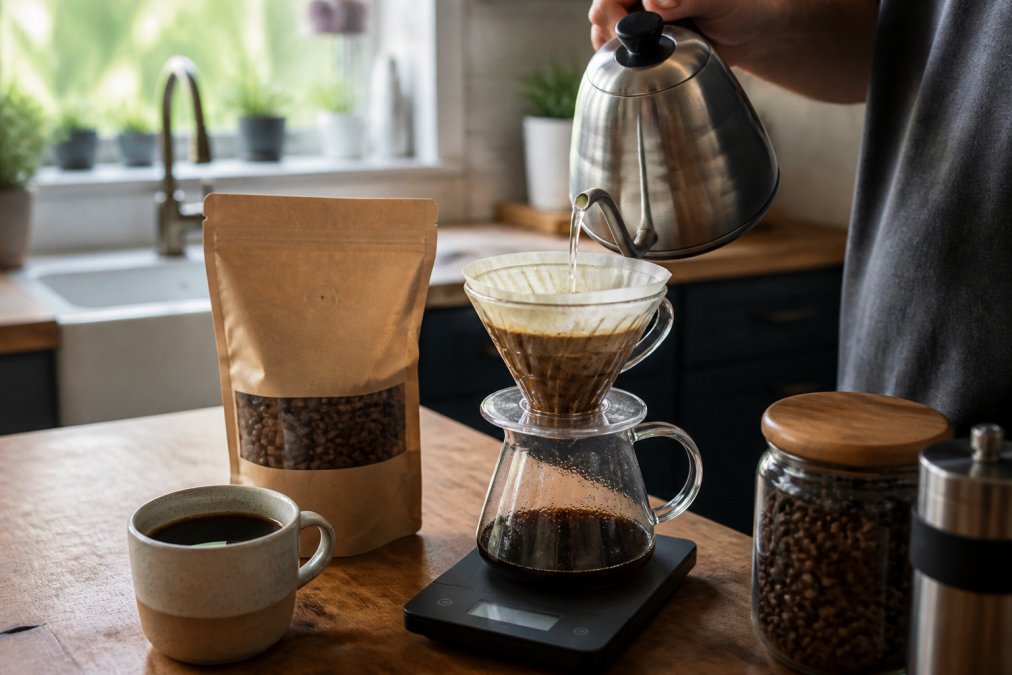
Pour-Over, Drip, French Press, and Espresso Compared
| Method | Grind | Time | What It Highlights |
|---|---|---|---|
| Pour-over | Medium-fine | 3-4 min | Acidity, floral notes |
| Drip | Medium | 5-6 min | Balance, consistency |
| French press | Coarse | 4 min steep | Body, sweetness |
| Espresso | Fine | 25-30 sec | Intensity, crema |
Grind Size by Brewer, Tuned for Kona's Density
Because Kona beans are dense, the same grinder setting that produces a proper medium grind for a softer bean will run slightly coarse for Kona. The practical fix is to start one click finer than your usual setting and adjust from there.
- Pour-over (V60, Chemex, Kalita): medium-fine, roughly the texture of table salt. On a Baratza Encore, start around setting 14-16. On a Comandante C40, start around 22-24 clicks. Target a 3:00-3:30 total brew time for a 15 g dose.
- Drip machine: medium, similar to coarse sand. On a Baratza Encore, start around 18-20. If your machine finishes a full pot in under five minutes, go one step finer.
- French press: coarse, roughly the texture of raw sugar. On a Baratza Encore, start around 28-30. Steep four minutes, then press slowly to avoid stirring up fines.
- Espresso: fine, finer than table salt but not powder. On a Baratza Sette 270, start around 7-9. Aim for a 1:2 ratio in 25-30 seconds for a 18 g dose.
- Cold brew: coarse, same as French press. Use a 1:8 concentrate ratio and steep 14-16 hours at room temperature.
Water Chemistry: The Variable Nobody Talks About
- Total dissolved solids (TDS): aim for roughly 75-125 ppm. Water below 50 ppm tastes flat and under-extracts; water above 200 ppm mutes the fruit notes and pushes the cup toward chalky or bitter.
- Chlorine and chloramine: both flatten aroma. A simple carbon filter pitcher removes most chlorine; chloramine needs a catalytic carbon filter or a pinch of ascorbic acid.
The Reserve Medium at $19.95 is the most forgiving bag here. It works in all four methods without a bad result, which makes it the safe pick if you brew differently day to day.
Kona Crown Roast Discovery Sampler Pack →
How to Store Fresh Roasted Coffee Beans So Flavor Lasts
Fresh roasted coffee beans start losing aroma within days of roasting, and the two main enemies are oxygen and light. What most storage guides leave out is the mechanism: roasted coffee releases carbon dioxide for the first several days after roasting, and that off-gassing is what pushes oxygen out of a sealed bag. Once off-gassing slows, usually around day 7 to 10, oxygen starts winning, and the delicate floral and citrus notes that define Kona are the first thing to go.
What Actually Happens to Kona Beans Over Time
- Days 1-3: heavy off-gassing. Bags with one-way valves will puff up. Brewing now often tastes flat because CO2 interferes with extraction.
- Days 4-14: the sweet spot for most Kona roasts. Aromatics are at their peak and extraction is stable.
- Days 15-30: fruit and floral notes fade first, followed by acidity. The cup gets flatter and slightly papery.
- Beyond 30 days: the coffee is still drinkable but no longer tastes like the coffee you paid a premium for.
This is why the roast date on the bag tells you more than a best-by date ever will. A best-by date is typically set months out and says nothing about how long the beans have already been sitting.
The Storage Rules That Actually Matter
- Keep the bag sealed between uses. The one-way valve on a good coffee bag lets CO2 escape without letting oxygen in, do not puncture or tape over it.
- Store at room temperature, away from the stove. Heat accelerates the same oxidation reactions you are trying to slow.
- Use an opaque or amber container. Light degrades the oils on the bean surface, which carry much of the aroma.
- Buy in amounts you will finish within a few weeks. A 7 oz bag every two weeks is a reasonable pace for one daily drinker.
- Grind right before brewing. Ground coffee has far more surface area exposed to oxygen, so it stales in days rather than weeks.
Should You Freeze Kona Coffee?
- Freezing whole beans for long-term storage works if you portion them into airtight, one-way-valve bags or vacuum-sealed jars and let them come to room temperature before opening. Moisture is the risk, so the seal has to be complete.
- Freezing and re-freezing the same bag does not work. Each thaw cycle pulls condensation onto the beans, and the flavor degrades quickly.
- Do not store beans in the fridge. The fridge is a humid, odor-rich environment, and coffee absorbs both.
Kona Crown Coffee roasts in small weekly batches and ships via 2-day FedEx, so the gap between roast and doorstep stays short. That shipping speed is doing as much for freshness as any container you buy.
Subscription vs One-Time Purchase: Which Fits Your Brewing Habit
Buy a subscription if you drink coffee daily and want a steady supply. Buy one-time if you brew a few times a week, or if you are still testing roast levels.
Frequently Asked Questions
How can you tell if Kona coffee is genuine or a blend?
Check the label for the words '100% Kona' rather than 'Kona blend' or 'Kona roast.' A true 100% Kona product lists only Kona coffee as the origin, and reputable sellers can show Hawaii State certification for the lot. Blends are allowed to contain as little as 10% Kona beans, so the remaining 90% can be cheaper coffee from other regions. If the price looks unusually low for Kona, the bag is almost certainly a blend.
What is the best grind size for brewing Kona coffee at home?
Match the grind to your brewer. Medium grind suits drip machines and flat-bottom pour-over, medium-fine works for cone pour-over, coarse fits French press and cold brew, and fine is reserved for espresso. Kona beans are dense, so a burr grinder set slightly coarser than you would use for a softer bean often extracts more evenly. Grind right before brewing, since ground coffee loses aroma within about 15 minutes of exposure to air.
How should you store Kona coffee to maintain peak freshness?
Keep whole beans in an airtight, opaque container stored in a cool, dark cabinet away from the stove. Heat, light, moisture, and oxygen are the four things that flatten flavor fastest. Buy in quantities you will finish within two to four weeks of the roast date, and avoid transferring beans into the freezer unless the bag is vacuum sealed. If you do freeze, portion it out first so you never thaw and refreeze the same beans.
Does roast level affect the flavor profile of Kona beans?
It changes the cup considerably. A medium-light roast keeps bright, citrusy notes and delicate sweetness, which suits pour-over and cold brew. Medium roast delivers the smooth, balanced character most people associate with classic Kona and works across drip, pour-over, and French press. Medium-dark and darker roasts bring raw sugar, brown malt, and a bittersweet finish that holds up well in espresso and milk drinks. Sampling several roasts side by side is the fastest way to find your preference.
Why is small-batch roasting preferred for premium Kona coffee?
Small batches let a roaster control time and temperature closely, so each lot develops evenly instead of scorching or baking. Because Kona beans are grown in limited quantities on small farms, the volume naturally suits batch roasting. Freshness matters just as much: coffee tastes best within two to four weeks of the roast date, so a bag roasted weekly and shipped within days of roasting arrives far closer to peak than one that sat in a warehouse.