
Table of Contents
- What the Label Actually Means: Kona Blend vs 100% Kona
- The 10% Minimum: What Kona Coffee Labeling Laws Require
- Geographic Origin and Growing Conditions: The Kona District
- Why Is Kona Coffee So Expensive Compared to Blends?
- Taste Test: Flavor Profile Differences You Can Actually Detect
- How to Identify Authentic Kona Coffee Before You Buy
- Price-Per-Ounce Breakdown: What You're Really Paying For
- Frequently Asked Questions
Last Updated: October 4, 2026
What the Label Actually Means: Kona Blend vs 100% Kona
Walk down any grocery aisle and you will see the word "Kona" printed on bags that contain almost none of it.
Here is the short version. A kona blend is a coffee product that contains some Kona coffee mixed with beans grown elsewhere. 100% Kona coffee is exactly what it says: every bean inside was grown in the Kona district on the island of Hawaii.

That distinction drives everything else, the price, the flavor, and how much you should trust the bag in your hand.
Below, we break down the labeling rules, the growing conditions, the flavor differences, and how to spot the real thing before you spend money on it.
The 10% Minimum: What Kona Coffee Labeling Laws Require
Hawaii law allows a bag to carry the word "Kona" with as little as 10% Kona beans inside. The remaining 90% can be coffee from anywhere in the world, and the label still does not have to shout it from the front.
The Hawaii Department of Agriculture coffee labeling guidance sets out the requirements producers must follow. The practical takeaway today is simple: the word "Kona" on a bag is not proof of origin.
The 10% Rule Is Being Replaced, Here Is the Timeline
Most articles on this topic are out of date. The 10% floor is a legacy standard, and the state has already passed legislation to tighten it. Here is how the rules actually shift:
- Through June 30, 2027: A product may be labeled as a Kona blend with as little as 10% Kona coffee by weight. The label must state the minimum percentage of Kona coffee it contains, but it does not have to disclose where the remaining beans were grown.
- On July 1, 2027: The minimum Kona content for any product labeled as a Kona blend rises to 51%. Below that threshold, the word "Kona" can no longer be used as a blend descriptor.
- Also on July 1, 2027: Labels must disclose the geographic origin of the non-Kona coffee, for example, "51% Kona coffee, 49% coffee grown in Brazil." That origin disclosure is the part most buyers have never seen on a bag.
If you are holding a bag today, the old 10% rule still applies. If you are buying in 2027 or later, the floor roughly quintuples. Either way, the burden of proof sits with the label, not with your assumptions.
Why the 10% Rule Exists at All
The 10% floor was originally a compromise. It let local roasters stretch a scarce, expensive crop across a larger volume of finished product while still giving buyers a taste of genuine Kona character.
The 2027 change is a direct response to that loophole. Raising the floor to 51% and forcing origin disclosure makes the blend label far more honest about what is actually in the bag.
Understanding Coffee Grading Systems
Kona coffee is graded by bean size, density, and uniformity, not by flavor. The top grades, Extra Fancy and Fancy, describe the largest and most consistent beans. Prime is a step below and shows more natural variation.
Grade tells you about consistency and appearance. It does not tell you whether the coffee is 100% Kona. A bag can be Prime grade and still be blended with foreign beans, because the grade applies to the Kona portion only.
How to Read Coffee Labels Without Getting Fooled
Look for the exact phrase "100% Kona Coffee." Anything else is a blend, and after July 1, 2027, anything under 51% Kona cannot legally call itself a Kona blend at all.

- "Kona Blend," "Kona Style," or "Kona Roast" all signal a mixture
- "Made with Kona coffee" tells you nothing about the ratio
- "Product of Hawaii" can appear on blends
- A specific farm name plus "100%" is the strongest signal
- After mid-2027, look for a stated percentage and the origin of the non-Kona beans
Geographic Origin and Growing Conditions: The Kona District
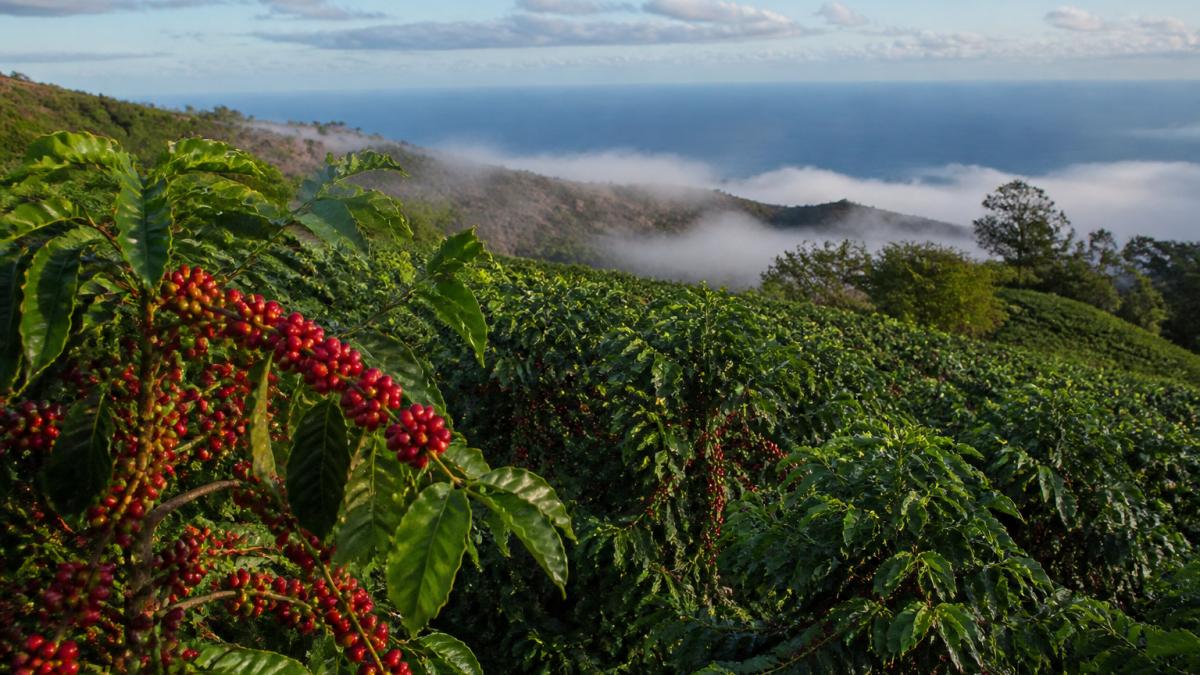
Kona coffee can only come from one place: the western slopes of the Big Island of Hawaii, in a narrow belt known as the Kona district.
Volcanic Soil, Altitude, and Microclimate
The Kona district sits on volcanic soil that drains quickly and holds minerals well. Coffee grows best at elevation, and the Kona belt generally sits between roughly 700 and 2,500 feet, where cooler air slows the ripening of the coffee cherry.
That slower ripening is the whole game. It gives the bean more time to develop sugars and acids, which is why Kona coffee tends to taste cleaner and more balanced than coffee grown at lower, hotter elevations.
Why Is Kona Coffee So Expensive Compared to Blends?
Kona coffee is expensive because it is scarce, hand-picked, and grown on land that cannot be expanded.
Labor is the other driver. Coffee cherries on Kona farms are typically picked by hand, and only the ripe ones are taken.
Then there is the grading and certification step. Beans are inspected and sorted, and the best lots command the highest prices.
100% Kona Coffee - Estate Medium Dark Roast →
Taste Test: Flavor Profile Differences You Can Actually Detect
You do not need to be a coffee expert to taste the difference, but you do need to know what to look for.
A kona blend is more variable. Because the non-Kona portion often comes from commodity coffee, blends frequently taste flatter, harsher, or more generic.
Here is how the two compare on the qualities that matter most:
| Attribute | Kona Blend | 100% Kona |
|---|---|---|
| Kona content | As low as 10% | 100% |
| Flavor profile | Variable, often flat | Smooth, balanced, clean |
| Bitterness | Often higher | Low |
| Sweetness | Inconsistent | Gentle, natural |
| Price per ounce | Lower | Higher |
| Origin traceability | Limited | Full |
The comparison is not close once you taste them side by side. Brew both with the same method and the difference shows up in the first sip.
How to Identify Authentic Kona Coffee Before You Buy
Authenticity comes down to verification, not marketing. The strongest signal is a bag that states "100% Kona Coffee" and names the farm or estate that grew it.
Our green coffee is Hawaii State Certified Kona coffee, meaning each lot is officially inspected and graded by the state. The U.S. Food and Drug Administration labeling requirements also govern how food products, including coffee, must present their claims, so misleading origin statements carry real regulatory weight.
A short checklist before you buy:
- Does the bag say "100% Kona Coffee" word for word?
- Is a farm, estate, or grower named?
- Is there a state certification or grade listed?
- Does the price match the reality of 100% Kona?
- Is the roast date printed, not just a best-by date?
Price-Per-Ounce Breakdown: What You're Really Paying For
Price per ounce is where the kona blend versus 100% Kona question becomes concrete. A blend spreads its cost across mostly cheap imported beans, so the per-ounce price stays low. A 100% Kona bag concentrates all of its cost into a scarce, hand-picked, graded product. But the sticker price alone does not tell you whether the premium is worth it.
The Math That Matters: Cost Per Ounce of Actual Kona
Here is the framework most buyers never run. Take the bag price, divide by the net weight in ounces, and then divide again by the Kona percentage.
- A 10% blend at a low shelf price looks cheap per ounce of total coffee, but once you divide by 0.10, the cost per ounce of actual Kona is often several times higher than a pure bag.
- A 51% blend (the post-2027 floor) cuts that multiplier roughly in half compared to a 10% blend, but it still carries a premium over the commodity beans filling the rest of the bag.
- A 100% Kona bag has a multiplier of 1. Every ounce you pay for is Kona. There is no dilution, no hidden commodity filler, and no origin question.
Run the numbers on any two bags side by side and the "cheaper" blend frequently loses on a per-ounce-of-Kona basis. The blend only wins if you are comparing raw total weight, which is not what you are drinking.
What the Premium Actually Pays For
You are not just paying for flavor. You are paying for origin verification, hand labor, small harvests, and the certification that proves the beans came from where the label says. Each of those has a real cost that a blend avoids:
- Hand-picking: Kona cherries are typically picked selectively by hand across multiple passes in a single season. That labor is not mechanized and cannot be scaled the way commodity harvesting is.
- Small harvests: The Kona district is a fixed, narrow belt. Supply cannot expand to meet demand, so the price reflects scarcity rather than markup.
- Grading and certification: Beans are inspected and sorted, and the best lots command the highest prices. A blend skips most of this by filling the bag with cheaper imported coffee.
- Freshness and shipping: Small-batch roasting and fast shipping add cost that a warehouse-stored blend does not carry.
A Practical Way to Decide
Ask yourself one question: do you want to taste Kona, or do you want a coffee that merely mentions it? If you want the flavor, the per-ounce-of-Kona math favors the pure bag.
For home roasters, buying green beans changes the math further. Our 100% Kona Coffee Green Estate Beans for Home Roasters - Hawai'i State Certified start at $42.00 and let you control the roast profile yourself, which stretches the value of every pound.
For drinkers who want the finished cup, our roasted options start at $18.95 for the 100% Kona Coffee - Estate Medium Dark Roast, with the Reserve line at $19.95.

Frequently Asked Questions
What does 'Kona blend' actually mean on a coffee label?
A Kona blend contains at least 10% Kona coffee beans mixed with other coffee, typically cheaper varieties from other regions. The remaining 90% can come from anywhere and often does. This means a bag labeled 'Kona blend' might contain only a small fraction of actual Kona coffee, which is why the flavor profile can taste closer to commodity coffee than authentic Kona.
How can I identify authentic 100% Kona coffee?
Look for the words '100% Kona' on the front of the bag, not just 'Kona blend' or 'Kona roast.' Check for a State of Hawaii certification seal, which verifies the coffee was grown and graded in the Kona district. Reputable sellers also list the specific farm or estate name. If the price seems too low for Kona, it probably is not 100% Kona.
Why is 100% Kona coffee more expensive than blends?
Kona coffee is expensive because of limited supply and high production costs. The Kona district produces a small fraction of the world's coffee, and all harvesting is done by hand on steep volcanic slopes. Labor, land, and processing costs are significantly higher than in mass-production regions. A 10% Kona blend spreads those costs across cheaper beans, which is why it costs far less per ounce.
Does a Kona blend contain any actual Kona coffee?
Yes, but only a minimum of 10% under current labeling requirements. The other 90% can be any coffee from any origin. Some blends use higher percentages, but unless the label specifies the exact ratio, you cannot know how much Kona is actually in the bag. If the Kona content matters to you, look for explicit percentage claims or buy 100% Kona instead.