
Table of Contents
- What Makes Kona Coffee Different From Other Origins
- 100% Kona Coffee vs. Kona Blend: Understanding the Legal Distinction
- How to Read a Kona Coffee Label for Authenticity Claims
- Kona Coffee Grades Explained: What Extra Fancy, Fancy, and Prime Mean
- Verifying Traceability and Origin: What Proof to Ask For
- Where to Buy 100% Kona Coffee: Direct Farm Sources vs. Retailers
- Common Misleading Claims and How to Spot Them
- Frequently Asked Questions
Last Updated: October 11, 2026
What Makes Kona Coffee Different From Other Origins
Kona coffee grows on the volcanic slopes of Hualalai in Hawaii at elevations between 2,000 and 4,000 feet. The afternoon cloud cover, rich volcanic soil, and consistent temperatures produce a distinctive smooth body and balanced flavor profile. The volcanic soil's minerals and high altitude slow bean maturation, allowing complex flavors to develop.
Brazilian coffee tends toward chocolate and nutty notes; Colombian coffee shows bright acidity. Kona coffee occupies a middle ground: smooth sweetness with subtle brightness and clean finish. That balance is what makes it distinctive, and understanding how to identify authentic 100% kona coffee matters for your purchase.

100% Kona Coffee vs. Kona Blend: Understanding the Legal Distinction
In Hawaii, "100% Kona coffee" means the entire contents came from the Kona region. A "Kona blend" can legally contain as little as 10% Kona beans mixed with cheaper beans. Because Kona production costs more, farmers increase profit margins by blending small amounts of Kona with lower-cost beans. If you want the flavor profile Kona is known for, you need 100% Kona coffee. The word "blend" on the package signals to check the percentage statement on the back.
At Kona Crown Coffee, we focus exclusively on 100% Kona coffee because anything less compromises the experience you're paying for. Our award-winning coffees come from our family-owned 42-acre farm on Hualalai's slopes, ensuring complete control over quality from harvest through roasting.
How to Read a Kona Coffee Label for Authenticity Claims
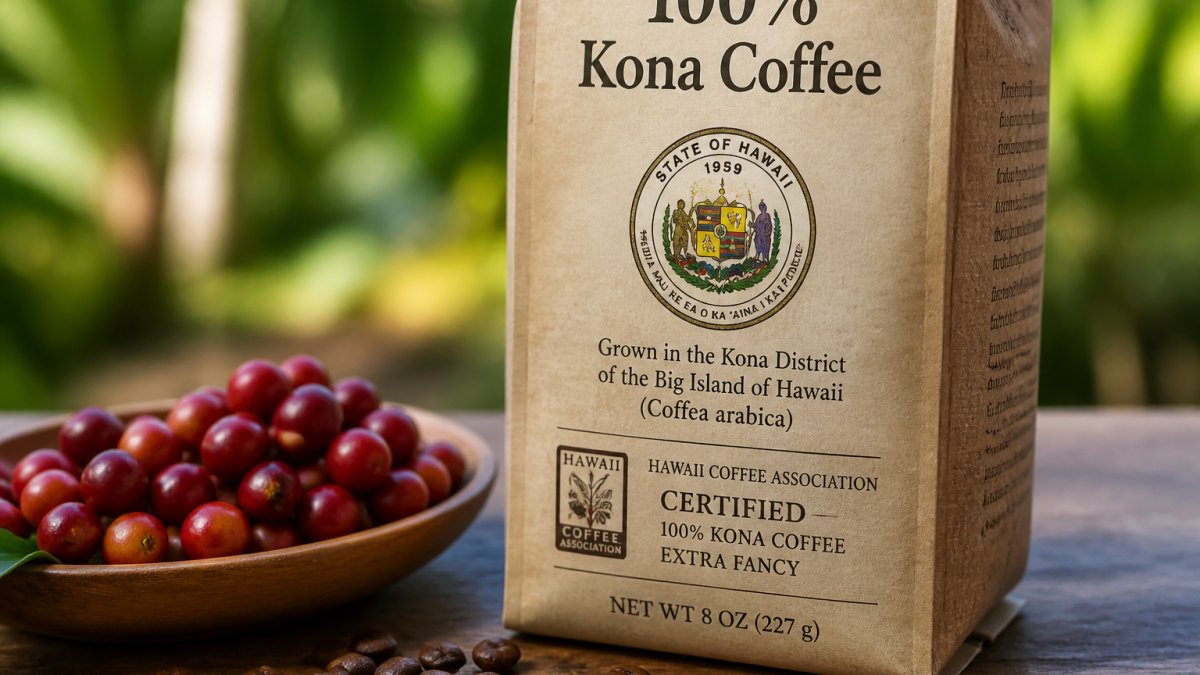
Learning how to identify authentic 100% kona coffee starts with reading a label correctly to know what to check, where to find it, and what each element legally means. The front of the package is marketing; the back and sides contain the verification details you need.
The Label Verification Checklist
Use this step-by-step process every time you evaluate a bag:
Step 1: Check the percentage claim on the front or back. Look for the exact phrase "100% Kona Coffee." If you see "Kona blend," "Hawaiian blend," "Kona-style," or any qualifier other than "100%," the bag contains non-Kona beans. Under Hawaii state law, a "Kona blend" can legally contain as little as 10% Kona coffee. If no percentage is listed, assume it is a low-percentage blend.
Step 2: Verify the Hawaii state certification mark. Look for the official state seal or a certification mark referencing the Hawaii Department of Agriculture. This indicates the coffee was inspected and verified to originate in the legally designated Kona region.
Step 3: Identify the grade on the label. Kona coffee is graded into four categories: Extra Fancy, Fancy, Prime, and Peaberry. The grade reflects bean size and uniformity, not flavor quality. All grades are authentic Kona coffee.
Step 4: Look for farm name, cooperative, or origin details. Legitimate sellers identify their specific source by farm name (e.g., "Darnall Estate"), cooperative name, or roaster affiliation.
Step 5: Check the roast date. Coffee flavor peaks within 2-4 weeks of roasting. Look for a roast date on the label. If none is printed, ask the seller before you buy.
Understanding Legal Labeling Requirements vs. Quality Signals
Not all label elements are legally required, and understanding the difference protects you from misleading packaging.
Legally required for 100% Kona coffee:
- The phrase "100% Kona Coffee" or equivalent (required by Hawaii law)
- The Hawaii state certification mark or grading information (required by Hawaii Department of Agriculture regulations)
- Net weight and ingredient statement (required by federal FDA labeling rules)
Not legally required but indicate transparency and quality:
- Farm name or cooperative affiliation
- Roast date
- Processing method (wet-processed, dry-processed, etc.)
- Roast level (light, medium, dark)
- Lot or harvest information
- Seller contact information or website
A seller can legally sell 100% Kona coffee with only the minimum required information. However, sellers who provide farm names, roast dates, and processing details are signaling that they stand behind their product and want you to verify it. This transparency is a quality indicator, even though it is not legally mandated.
Red Flags: Packaging Language That Signals Blends or Counterfeits
Vague or evasive origin language Phrases like "Kona-style," "inspired by Kona," or "roasted in Hawaii" indicate the coffee is not from the Kona region. Legitimate Kona coffee states the origin directly.
Missing state certification or grading marks If the package shows no Hawaii Department of Agriculture certification, grading mark, or reference to state inspection, the origin claim is unverified.
Prices significantly below market rates Authentic Kona coffee costs more than most origins because production costs are higher: labor, land, and processing are expensive in Hawaii.
Poor label quality, misspellings, or inconsistent branding Legitimate producers invest in professional packaging. Sloppy design, misspellings, or faded printing suggest the seller cut corners on packaging and likely on sourcing.
Kona Coffee Grades Explained: What Extra Fancy, Fancy, and Prime Mean
Hawaii's grading system classifies Kona coffee beans by size and visual uniformity, not flavor quality. Extra Fancy represents the largest, most uniform beans. Fancy grade offers excellent consistency with slight natural variation. Prime grade shows more variation and offers excellent quality at lower cost. Peaberry is a rare natural mutation where two beans fuse into one, typically costing more. Choose based on your priorities: Extra Fancy for uniformity, Fancy or Prime for authentic flavor at reasonable price. Our 100% Kona Coffee Green Estate Beans for Home Roasters come in all grades.
Verifying Traceability and Origin: What Proof to Ask For
Traceability means you can trace the coffee from your cup back to the specific farm, lot, and processing details. Legitimate sellers provide this information in writing. Asking for proof before you buy is the final step in verifying authenticity.
What Documentation Credible Sellers Can Provide
Farm name and location Reputable sellers identify their source by name and location. Ask the seller for the farm name. Many farms have websites where you can verify their location and certifications.
100% Kona Coffee Green Estate Beans for Home Roasters - Hawai'i State Certified →
Hawaii Department of Agriculture certification number Every bag of genuine Kona coffee is inspected and graded by the Hawaii Department of Agriculture.
Roast date and roast level Ask when the coffee was roasted and at what roast level.
Processing method and lot information Ask how the coffee was processed. Kona coffee is typically wet-processed (washed). Some producers use natural (dry) processing, which is rarer.
Roaster name and contact information Small-batch roasters can tell you the roast date, roast level, and lot information. Roasters who provide their name and contact information on the label invite you to verify their claims.
What Testing and Regulatory Checks Can and Cannot Establish
What official certification proves: The Hawaii Department of Agriculture certification proves that the coffee originated in the legally designated Kona region and passed official inspection for bean size, defects, and moisture content.
What certification does not prove: Certification does not prove the coffee was roasted recently, stored properly, or brewed correctly. It does not guarantee flavor quality or freshness. It does not verify the roaster's reputation or the seller's business practices.
What independent lab testing can show: Independent labs can test coffee for origin using isotope analysis or chemical fingerprinting.
What independent testing cannot show: Lab testing cannot determine roast date, freshness, or flavor quality. It cannot verify the seller's business practices or whether the coffee was stored properly. Testing is useful for confirming origin but not for assessing quality or freshness.
Red Flags: When a Seller Cannot or Will Not Provide Proof
Seller cannot name the farm or cooperative: If a seller cannot name specific sources, you cannot verify the origin. Legitimate sellers know their sources and name them.
No roast date provided: If a seller cannot tell you when the coffee was roasted, it may have been sitting in storage for months.
Seller refuses to provide the Hawaii Department of Agriculture certification number: Every genuine Kona coffee has a certification number. Request it before you buy.
Seller cannot explain processing method or lot information: Sellers who understand their coffee can explain these details. If they cannot, they may lack direct knowledge of the coffee's origin or quality.
Seller has no contact information or website: Legitimate sellers provide ways to contact them and verify claims. No website, email, or phone number is a red flag.
How to Report Suspected Mislabeling
If you purchase coffee that is labeled "100% Kona" but you suspect it is a blend or counterfeit, you can report it to the Hawaii Department of Agriculture. Provide the seller name, product name, label information, and your reason for suspicion. The department investigates complaints and can take enforcement action against sellers who mislabel coffee. You can also report suspected mislabeling to the Federal Trade Commission (FTC) if you believe the seller made false advertising claims. Reporting helps protect other consumers and holds sellers accountable for accurate labeling.
Where to Buy 100% Kona Coffee: Direct Farm Sources vs. Retailers
Direct-from-farm purchases offer the shortest supply chain and maximum freshness. Farm-direct sellers provide detailed information about beans, roasting schedule, and processing methods, and you can ask questions directly. Retail stores offer convenience and selection but introduce more steps between roaster and consumer, affecting freshness. When buying from retailers, prioritize sellers with strong reviews and transparent sourcing information. Specialty coffee shops often source directly from small farms and can answer questions about origin and roast level.
Kona Crown Coffee sells directly to consumers through our website. Our award-winning coffees are roasted weekly in small batches and shipped via 2-day FedEx to ensure freshness. You receive coffee roasted within days of your order, not weeks or months after roasting.
Common Misleading Claims and How to Spot Them
Identifying authentic 100% Kona coffee protects your investment and ensures you experience the flavor you're paying for. Check labels for "100%," verify state certification, confirm the roast date, and ask sellers about their source. Our award-winning 100% Kona coffees are roasted fresh weekly on our 42-acre family farm and shipped directly to you within days. Shop our Reserve and Estate selections and taste the difference authenticity makes.

Frequently Asked Questions
How can you tell if Kona coffee is 100% authentic?
Check the label for three key markers: the statement '100% Kona Coffee' (not 'Kona blend' or 'Kona-style'), the Hawaii State seal or certification number, and the grading designation (Extra Fancy, Fancy, or Prime). Ask the seller for traceability information, such as the farm name or lot number. Authentic kona coffee should list the Kona district as the origin, not just Hawaii generally. Price is also a signal, genuine 100% Kona typically costs significantly more than blends due to limited growing area and strict labeling regulations.
What is the difference between 100% Kona coffee and a Kona blend?
100% Kona coffee contains only beans grown in the Kona region of the Big Island. Kona blends contain a percentage of Kona beans mixed with cheaper beans from other origins, often as low as 10%. U.S. labeling law allows blends to use the word 'Kona' on the front label if the percentage is disclosed on the back. This is why reading the full label is critical. A true 100% Kona coffee will explicitly state this on the front and meet Hawaii State certification requirements, while blends will show a percentage and may lack official state grading.
What questions should you ask a seller before buying Kona coffee?
Ask for the farm name, harvest date, and roast date to verify freshness and traceability. Request the Hawaii State grading certificate or lot number. Inquire whether the beans were roasted on-site or by a third party. Ask about their sourcing relationship with the farm, direct-to-consumer sellers can often provide more detailed origin information than wholesale retailers. Finally, confirm their return policy in case the coffee doesn't meet your expectations, which protects your investment in premium coffee.
Why is authentic Kona coffee more expensive than a blend?
Authentic kona coffee commands premium pricing due to strict geographic origin requirements, limited growing area on the slopes of Hualalai, and Hawaii State certification processes that verify authenticity and grading. Additionally, legitimate producers invest in small-batch roasting, careful processing, and traceability systems that add cost. Blends are cheaper because they substitute lower-cost beans from other origins, reducing quality and eliminating the distinctive flavor profile that makes genuine Kona coffee sought after.