
Table of Contents
- Why Kona Coffee Beans Need Careful Storage
- How Long Do Coffee Beans Last Once Opened?
- Best Container for Coffee Beans: A Practical Comparison
- Can You Freeze Coffee Beans? What Actually Works
- How to Store Coffee Beans in Bulk Without Losing Flavor
- Common Storage Mistakes That Ruin Kona Coffee
- Conclusion: Keep Your Kona Coffee at Its Peak
- Frequently Asked Questions
Last Updated: October 14, 2026
Why Kona Coffee Beans Need Careful Storage
To store kona coffee beans, keep them cool, dark, dry, and sealed tight. Kona beans are prized for a clean, balanced cup with gentle sweetness and low bitterness, a delicate profile that fades fast in open air.

Kona coffee is grown on the volcanic slopes of Hawaii, where small farms hand-pick and process each lot.
The enemies are predictable: oxygen, light, heat, and moisture. Beat all four and your coffee stays vivid for weeks.
The enemies of freshness: oxygen, light, heat, and moisture
Oxidation is the main thief: when oxygen meets the oils in roasted beans, those oils break down, leaving flat, papery, stale coffee.
Light speeds that up, heat pushes it faster still, and moisture turns beans soft and dull.
The U.S. Food and Drug Administration guidance on food storage notes that light, heat, and air all degrade the quality of stored foods. Coffee is no exception.
So the goal is a short list:
- Block oxygen
- Block light
- Avoid heat
- Avoid humidity
Every storage choice below serves one of those four jobs.
How Long Do Coffee Beans Last Once Opened?
Opened whole bean coffee stays at its best for about two to four weeks in a sealed container at room temperature. After that it is still safe, but aroma and flavor fade.
Ground coffee moves faster: more surface area means more air contact, so it loses its peak in days.
That is why we roast in small batches every week and ship by 2-day FedEx. Freshness is the whole point.
Roast date and roast level: what changes the clock
The roast date on the bag matters more than any "best by" label: a best-by date says when coffee is technically fine, the roast date says when it tastes best.
Darker roasts taste fresh a little longer because roasting drives off some compounds that go stale first. Lighter roasts show their brightness early, and that brightness is the first thing to go.
A simple rule:
- Buy from a roaster who prints the roast date
- Start drinking within a week of that date
- Finish the bag within a month
If a bag has no roast date, skip it.
Best Container for Coffee Beans: A Practical Comparison
The best container for coffee beans is an opaque, airtight one with a tight-fitting lid and minimal headspace, blocking light and oxygen at once.
| Container | Blocks Light | Blocks Air | Handles CO2 Off-Gassing | Best For |
|---|---|---|---|---|
| Original bag with one-way valve | Partly | Mostly | Yes, by design | Short-term, everyday use |
| Airtight canister (opaque) | Yes | Yes | No, needs burping | Most households |
| Mason jar | No | Yes | No, needs burping | Dark cabinets only |
| Vacuum storage container | Yes | Yes | No, needs burping | Longer storage |
| Refrigerator | No | No | No | Not recommended |
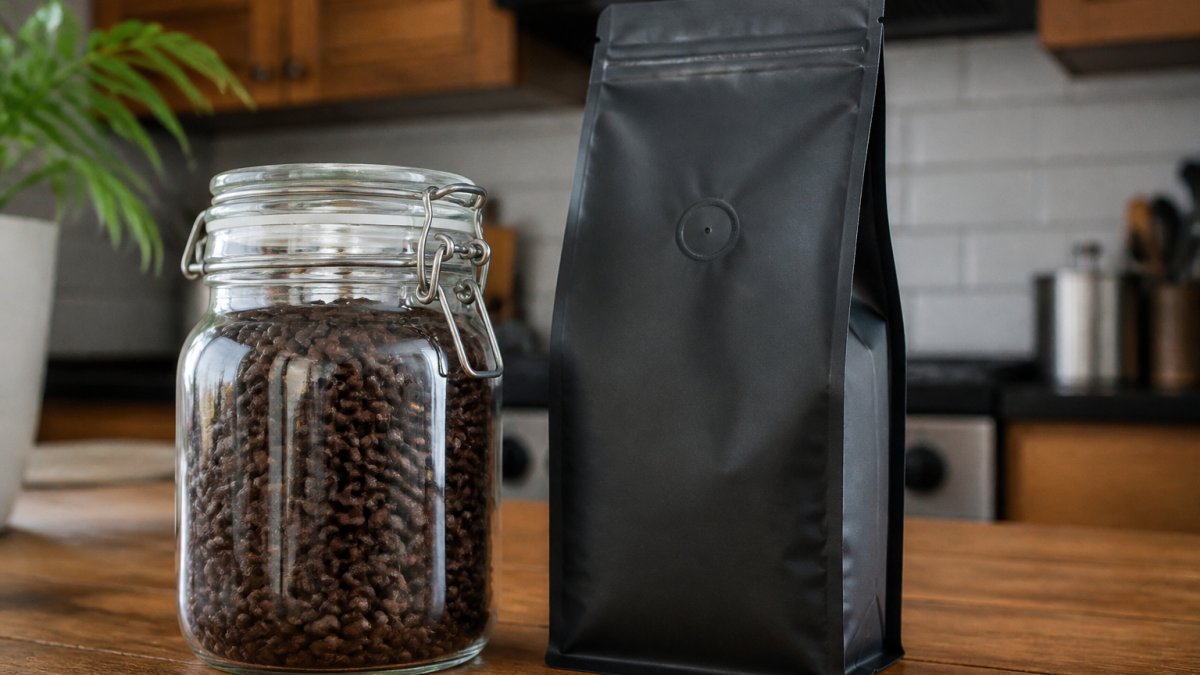
A clear mason jar looks great but lets light straight through, keep it inside a cabinet. Opaque canisters win for most kitchens: cheap, sealed, and light-blocking.
Why the one-way valve matters more than the bag
Many roasters ship coffee in a resealable bag with a one-way valve, a small silicone or foil flap that lets carbon dioxide escape without letting oxygen in. Freshly roasted beans release CO2 for several days, and without a valve that gas would balloon the bag or force past the seal.
If your bag has a valve, you can store beans in it for a couple of weeks: press out the extra air, reseal, and fold the top down.
Headspace, burping, and the seal that quietly fails
Headspace. Every time you open a canister, the air inside exchanges with room air.
Burping. A truly airtight canister traps the CO2 beans keep releasing. The pressure is harmless, but opening the lid lets gas escape and room air rush in.
Seal degradation. Silicone gaskets and clamp lids wear out. A gasket that no longer seats lets air trickle in, and you will not notice until the coffee tastes flat.
Matching the container to the roast and the climate
Roast level. Darker roasts have already driven off many volatile compounds that go stale first and release more CO2 early, so a dark roast in a sealed canister may need a burp in the first few days.

Humidity. In a damp kitchen or humid climate, moisture is the threat a loose seal lets in. There, an airtight container is the difference between crisp beans and soft, flat ones.
A final note on smell: coffee absorbs odors from whatever sits beside it. Whatever container you choose, keep it away from spices, onions, and cleaning supplies.
Can You Freeze Coffee Beans? What Actually Works
Yes, you can freeze coffee beans, and it works well if you do it right: the freezer slows staling and can hold peak flavor for months.
The mistake is freezing a bag you keep opening. Every time you pull it out, moisture condenses on the cold beans. That moisture is worse for coffee than the cold is good for it.
Portioning and thawing without condensation
Portion first, freeze once, thaw once. That is the whole rule.
100% Kona Coffee Green Estate Beans for Home Roasters - Hawai'i State Certified →
Here is how we would do it:
- Divide beans into portions you will use in about a week
- Seal each portion in an airtight, opaque container or vacuum bag
- Label each with the roast date
- Freeze them all at once
- Pull out one portion at a time
- Let it come to room temperature before opening
Step six matters most: opening a cold container lets humid air rush in and condense on the beans. Wait until it feels room temperature, then open it.
Do not refreeze. Once a portion is thawed, drink it.
How to Store Coffee Beans in Bulk Without Losing Flavor
Bulk storage works if you split the supply in two: a small working portion in your counter container, and the rest frozen or vacuum-sealed. That way you open one small container often while the bulk stays sealed and untouched.
For bulk amounts:
- Keep the working portion to about a week of coffee
- Seal the rest in vacuum bags or airtight containers
- Store bulk in a cool, dark, dry place or the freezer
- Label everything with the roast date
- Never store bulk near the stove, oven, or a sunny window
That is the standard playbook. What most guides skip is how Kona coffee changes the math, it is grown in a humid, tropical environment and often ships in packaging designed for that reality.

Opened versus unopened Kona packaging
A sealed valve bag of Kona coffee is a closed system: as long as the valve is intact and the bag unopened, the beans are protected from oxygen and their released CO2 keeps the interior atmosphere slightly positive.
The moment you open that bag, the clock changes: the valve still works, but the resealable zipper is now the weak point, and every open-and-close cycle lets air in.
If the bag has no valve and no resealable top, treat it as single-use. Transfer the beans to an airtight container the day you open it.
Humidity is the Kona-specific variable
Kona coffee is grown on the volcanic slopes of Hawaii, where humidity is part of the growing environment.
Moisture does two things to roasted beans: it softens them, dulling the grind and the cup, and it accelerates the reactions that make coffee taste stale.
A practical test: if your beans feel tacky or the grinder clogs, moisture has already gotten in. Move them to a fresh, dry container and check the seal.
Realistic storage duration by method
"How long do beans last" has two answers: peak flavor and basic usability. Here is a rough guide for whole-bean Kona coffee stored properly.
| Storage Method | Peak Flavor | Still Usable |
|---|---|---|
| Counter, airtight opaque container | 2-4 weeks after roast | 6-8 weeks |
| Original valve bag, resealed | 1-2 weeks after opening | 4-6 weeks |
| Freezer, portioned and sealed | 2-3 months | 6 months or more |
| Refrigerator | Not recommended | Not recommended |
These are ranges, not guarantees. Darker roasts hold their peak a little longer than lighter roasts, and ground coffee moves through the window in days rather than weeks.
If you roast at home, our 100% Kona Coffee Green Estate Beans for Home Roasters - Hawai'i State Certified are graded and inspected by the State of Hawaii, so you know exactly what you are storing.
One more point on smell: coffee absorbs odors from whatever sits beside it.
Common Storage Mistakes That Ruin Kona Coffee
Most ruined coffee comes down to a handful of habits. Fix these and your Kona beans taste the way the roaster intended.
The big ones:
- Leaving beans in a clear jar on a sunny counter
- Storing beans in the fridge for daily use
- Buying pre-ground coffee and storing it for weeks
- Keeping beans past their roast date window
- Refreezing thawed portions
- Storing beans next to strong-smelling foods
Each mistake costs you aroma. Some cost you the whole bag.
A common mistake is buying a large bag to save money, then storing it badly. The savings vanish when half the coffee goes stale.
What most guides miss is that humidity matters as much as air.
Conclusion: Keep Your Kona Coffee at Its Peak
Good storage is not complicated. Cool, dark, dry, and sealed covers almost everything. Add portioning and a roast date, and you are ahead of most coffee drinkers.
The harder part is starting with fresh beans. No container can rescue coffee that was already old when it arrived.
At Kona Crown Coffee, we small-batch roast every week and ship by 2-day FedEx, so your beans reach you close to their roast date. Our award-winning 100% Kona coffee comes from our family farm on the slopes of Hualalai and has won at the Kona Coffee Cultural Festival three years running. Try our 100% Kona Coffee - Estate Medium Dark Roast or the 100% Kona Coffee - Reserve - Medium Light for a brighter cup.
Get started with Kona Crown Coffee and taste what fresh, properly stored Kona coffee should be.
Frequently Asked Questions
How long do coffee beans last once opened?
Once opened, whole bean coffee stays at peak flavor for about 1 to 2 weeks, and noticeably declines after 4 weeks. For Kona coffee, which is prized for its smooth, balanced profile, aim to finish the bag within 2 to 3 weeks of opening. Store beans in an airtight container away from heat and light to slow oxidation. If you buy in bulk, freeze portions you won't use within that window.
Is it best to store coffee beans in the refrigerator?
No. The refrigerator exposes beans to moisture, temperature swings, and food odors every time you open the door. Those conditions speed up staling and can leave your Kona coffee tasting like last night's leftovers. Instead, keep beans in an airtight container in a cool, dark, dry place at room temperature, like a pantry shelf away from the stove. For longer storage, use the freezer, not the fridge.
Can you freeze Kona coffee beans?
Yes, freezing works well for Kona coffee if you do it right. Divide beans into portions you'll use in 1 to 2 weeks, seal them in vacuum-sealed bags or airtight containers, and freeze. When ready to use, thaw the sealed portion at room temperature without opening it, so condensation forms on the outside of the bag, not on the beans. Avoid repeatedly thawing and refreezing the same beans.
What is the best container for storing coffee beans?
An opaque, airtight container with a tight-fitting lid is your best bet. Vacuum-sealed containers or canisters with a one-way valve also work well because they limit oxygen exposure. Mason jars can work if stored in a dark cabinet. Avoid clear containers on open shelves, and skip the original bag unless it's resealable with a one-way valve and you plan to finish it quickly.